Rent the right bike and Chiang Mai opens up. The mountain is twenty minutes away, dinner is wherever you decide it is, and you stop planning your days around taxis. Rent the wrong one and you spend your holiday on soft brakes in one of the deadliest countries anywhere to ride a motorbike. Most guides tell you where to rent. This one is about what to rent, because on Thai roads the machine itself is most of the difference.
What you'll actually be offered
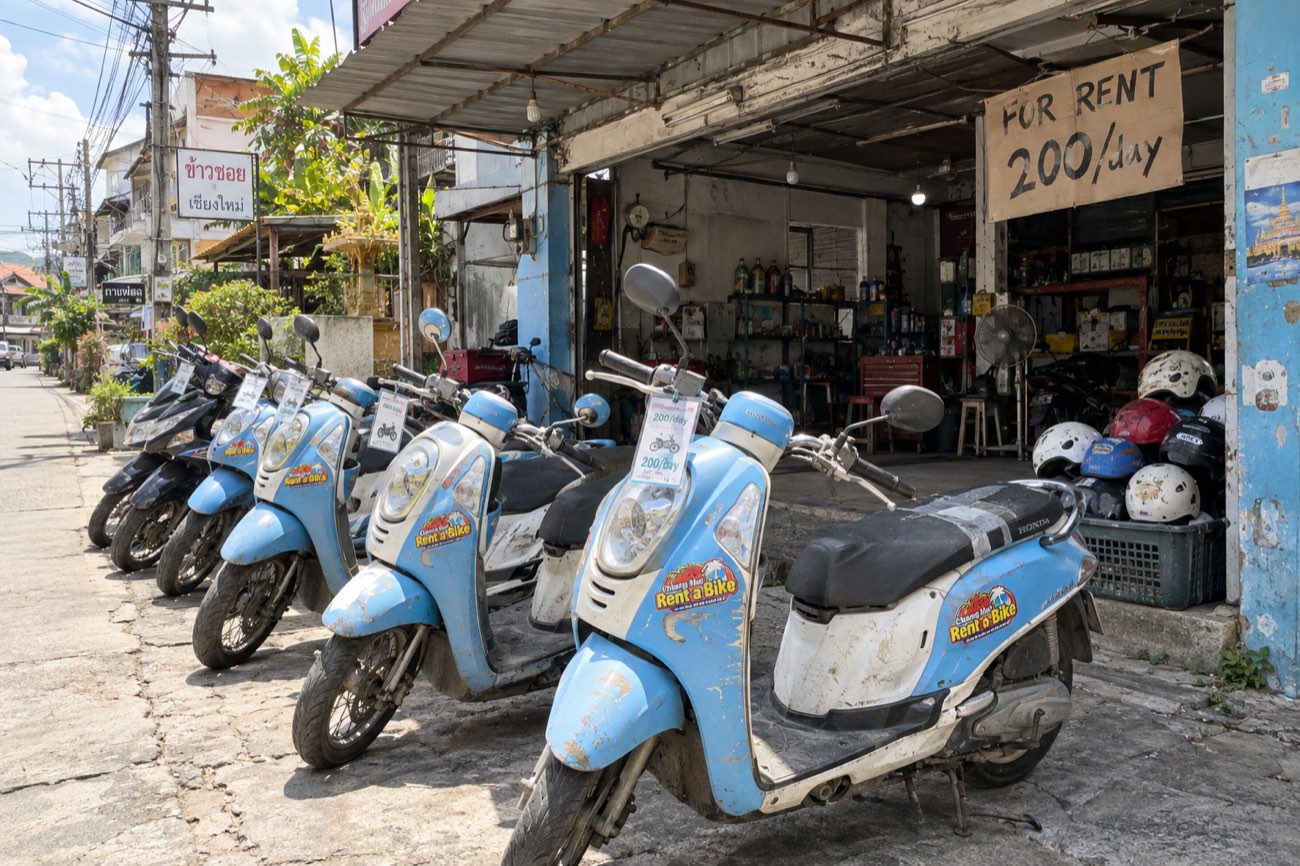
Walk past any cheap rental shop in the Old City and the same bike is lined up out front, over and over: a Honda Click 125, baby blue and white, seven or eight years old, a rental company sticker the size of a dinner plate across the front. Scratches on every panel, mirrors that have been down the road a few times, a front brake lever that comes halfway back to the bar before anything happens. It costs 150 to 250 baht a day, and it is the standard tourist rental across Thailand.
The age is the problem, not the paint. Brake pads, tyres and oil on these bikes are usually long past the point where they should have been replaced. And one thing no service can fix: no Honda Click 125 sold in Thailand has ever had ABS, in any version. For an experienced rider on dry tarmac that is a calculated risk. For someone whose last two-wheeled experience was a bicycle, on wet season roads, it is a genuinely bad idea.
ABS, in plain terms
ABS stops the wheels locking when you brake hard. Something runs into the road, you grab the front brake, and instead of the wheel locking and the bike going down, the system pulses the brake many times a second so the tyre keeps gripping and you keep steering. On a scooter a locked front wheel almost always means a crash; ABS is the difference between a scare and a hospital visit. In US insurance industry data, motorcycles with ABS are involved in 22 percent fewer fatal crashes than the same models without it.
Cheap rentals often advertise CBS, or combined braking, instead. CBS just links the two brakes together. It does nothing to stop a lock-up. It is not ABS, whatever the sticker implies.
This matters more in Thailand than almost anywhere. Riders and their passengers account for roughly three quarters of the country's road deaths, and the World Health Organization has ranked Thailand at the top of the world for motorcycle fatality rates. Yet most of the scooters at Thai rental shops, and nearly everything at the cheap end, has no ABS at all. On holiday, on unfamiliar roads, that is a strange place to save money.
The bikes you'll see at rental shops
Rental shops across Thailand stock the same handful of models. Here is the honest version of each, with the ABS situation as Honda and Yamaha actually sell them in Thailand. Versions change year to year, so treat the ABS column as "ask the shop", not gospel.
| Bike | Engine | ABS in Thailand | Weight | Best for |
|---|---|---|---|---|
| Honda Scoopy / Yamaha Fino | 110-125 cc | No | ~100 kg | Short hops, confident riders |
| Honda Click 125 | 125 cc | No, on any version | ~110 kg | The default cheap rental |
| Yamaha Grand Filano | 125 cc | Only the top version | ~102 kg | Style around town |
| Yamaha Aerox 155 | 155 cc | Only the top version, rear drum | 118 kg | The sporty look |
| Yamaha NMAX 155 | 155 cc | Yes on current model | ~131 kg | Comfortable all-rounder |
| Honda Click 160 | 157 cc | ABS version only, cheaper one has CBS | 118 kg | City riding, done properly |
| Honda PCX 160 | 157 cc | Only the top version | ~132 kg | Two-up comfort |
| Honda ADV 160 | 157 cc | Yes, plus traction control | 133 kg | Everything, including the mountains |
| Yamaha XMAX 300 | 292 cc | Yes | ~180 kg | Highway days, not city traffic |
A few things the table can't show. The little 110 and 125 cc bikes are light, cheap and easy to park, and completely fine for a confident rider pottering between cafes. The PCX is the comfortable armchair of the group and the usual pick for couples, but on most Thai-market PCXs only the more expensive version has ABS. The NMAX is Yamaha's answer and currently ships with ABS, though older rental units may not have it. The Aerox looks fast and keeps an old-fashioned rear drum brake even on its ABS version. At the far end, a 300 cc maxi scooter or a manual bike like the CRF300L is a fine machine for touring, but at 180 kilograms the XMAX stops fitting through the gaps that make a scooter the fastest thing in Chiang Mai traffic. Bigger is not better here; in town it is mostly just wider.
There is also the Honda Wave, the semi-automatic workhorse half of Thailand actually rides. No clutch lever, but you shift gears with your foot. If you have never done that, your holiday is not the time to learn.
Our pick: the Honda ADV 160
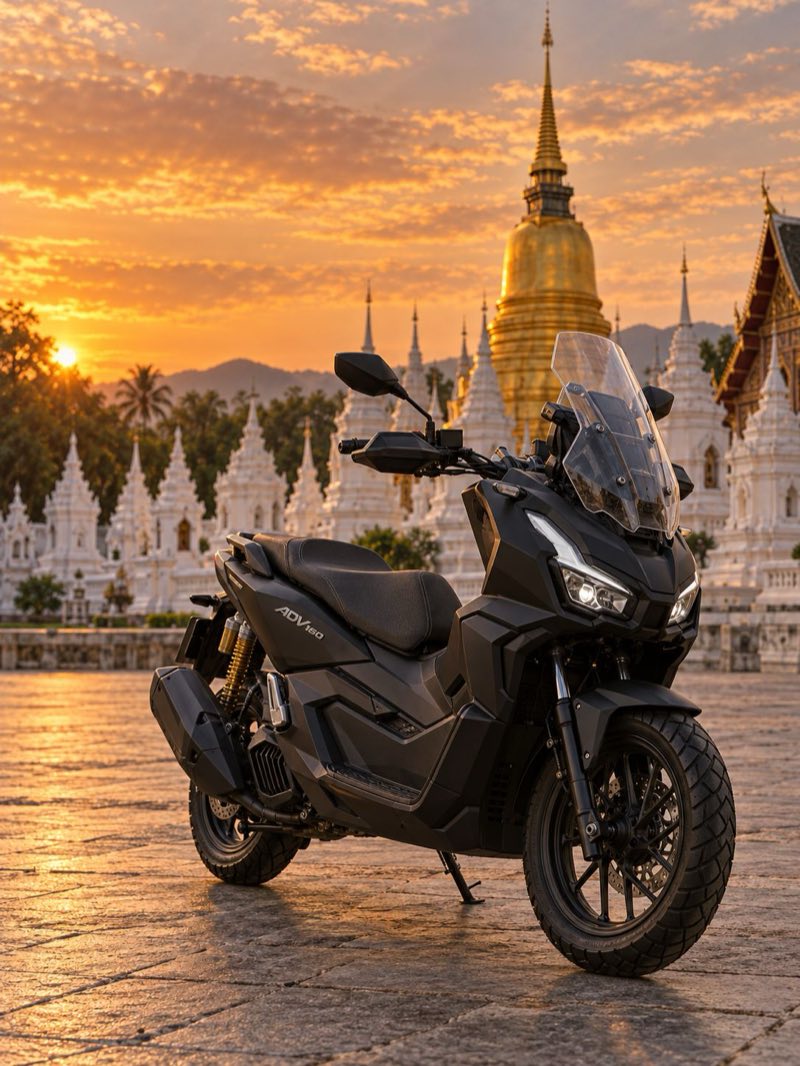
For anyone who wants an automatic and plans to see more than the inside of the Old City, the ADV 160 is the best thing you can rent in Thailand. It comes with ABS and traction control as standard, which on its own separates it from nearly everything else on this page. At 133 kilograms it is heavier than a Click, and that weight is exactly what you feel as stability: it sits planted at 80 on the canal road and doesn't get pushed around by wind or passing trucks on the way up Doi Suthep. It is still narrow enough to filter through stopped traffic, which the genuinely big bikes are not. Long-travel suspension and 165 millimetres of clearance mean speed bumps, broken tarmac and the occasional dirt lane simply stop being events.
Two honest caveats. The ADV costs more to rent than a Click, because it costs nearly twice as much to buy. And it is genuinely hard to find at rental shops, because shops that buy new bikes are rare. But in our experience, people who ride one once don't go back to a PCX: it rides smoother where the roads are bad, and most people think it looks better too. That part is taste. The ABS is not.
The smaller pick: Click 160, with ABS
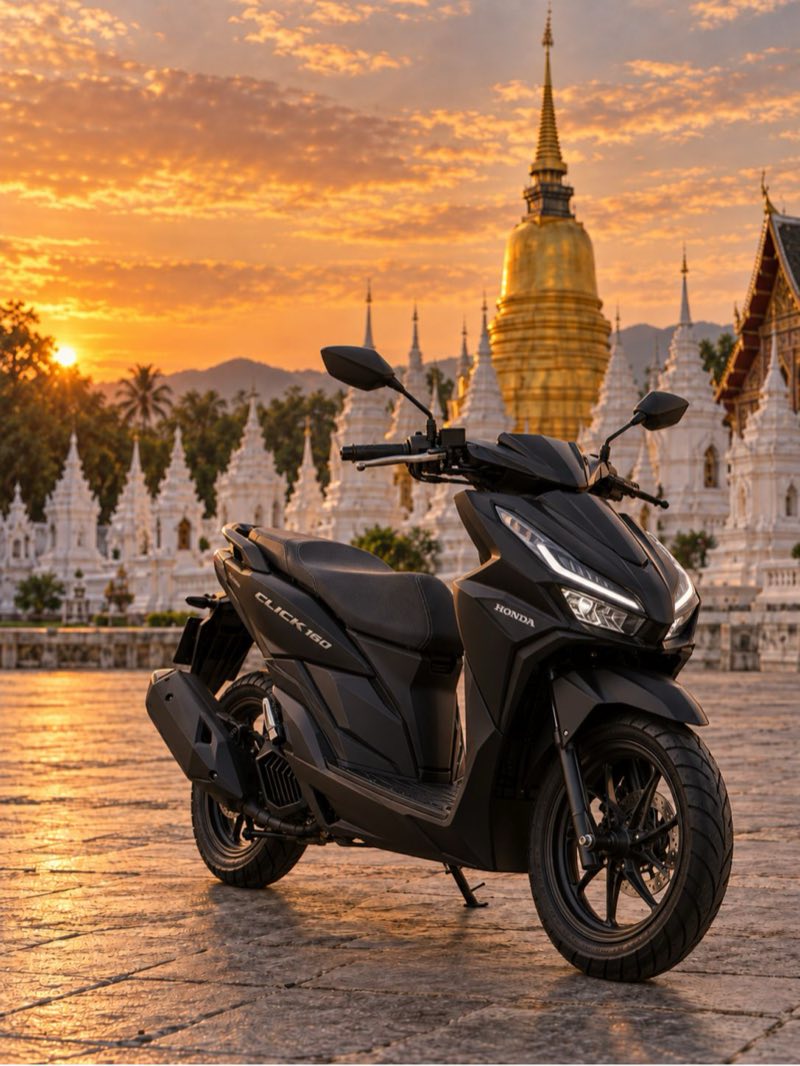
If the ADV feels like more bike than you need, the Click 160 is the one to ask for: light at 118 kilograms, quick enough for the canal road, nimble in traffic, easy to park anywhere. One catch, and it matters: the Click 160 is sold in Thailand in two versions, and the cheaper one has CBS, not ABS. Ask the shop which one you are getting. If they don't know what you mean, that is an answer too.
What a fair price looks like
Daily rates in Chiang Mai run roughly 150 to 250 baht for an older Click 125, 250 to 350 for a newer small scooter, and 350 to 500 and up for the PCX, NMAX and ADV class. Weekly rates knock a chunk off, and monthly rates change the arithmetic completely: a month often costs about the same as ten to twelve days at the daily rate, which is why anyone staying two weeks or more should price a longer rental before defaulting to day-by-day.
Read the cheap end of that range as information, not luck. The 150 baht bike is almost always the oldest bike in the row, and on a scooter the state of the bike is your braking distance.
The licence question, briefly
Thailand requires a licence that covers motorbikes: a Thai motorcycle licence, or your home motorcycle licence with an international driving permit that includes the motorcycle category. A car licence does not count, and neither does a car-only IDP. Police checkpoints around Chiang Mai check, the fines recur, and more importantly an invalid licence can void your insurance, travel cover included. Any shop that rents to you without ever asking is telling you something about how they'll handle the rest of the relationship too.
Red flags at the rental counter
- They want your passport as the deposit. The UK government's Thailand travel advice says it plainly: don't hand your passport to vehicle rental businesses, because companies may hold it against claimed damage. A shop holding your passport holds every negotiation. Reputable shops take a copy and a cash deposit, and hand the document straight back.
- Everything they have is old. One tired bike is bad luck. Twenty of them tells you how the shop treats its machines, including the parts you can't see.
- Nothing they rent has ABS. You now know what to ask. A shop where the answer is no on every single bike made its choice on your behalf.
- No walk-around at handover. Pre-existing scratches billed to tourists at return is the classic Thai rental scam, with made-up repair bills documented in the thousands of baht. A good shop photographs the bike with you before you ride off. Do your own timestamped video regardless.
- The helmets are an afterthought. Cracked, strapless or one size fits nobody. The helmet law is enforced in Chiang Mai, and the fine is the least of the reasons to care.
- Nothing is in writing. No agreement, no stated deposit, no word on insurance. Everything is negotiable later, and later you lose.
Where this leaves you
Ask for ABS by name, look at the bike's age before you look at the price, and never leave your passport behind the counter. If you want the short version of everything above: it is the checklist we built RideMate around. We rent exactly three bikes - the ADV 160, the lighter ADV 150, and the Click 160 in the ABS version - all recent models, all with ABS, delivered free anywhere in Chiang Mai with two helmets, servicing and a backup bike included, by the week or the month. Your passport never leaves your hands.